Why Moisture Control Is Critical for Transformer Reliability
A smart breather for transformers plays a critical role in preventing moisture contamination and improving transformer reliability in modern substations.
Transformer performance depends heavily on insulation health and transformer oil quality. One of the biggest hidden threats to both is moisture contamination.
Even small amounts of atmospheric moisture entering a transformer can reduce dielectric strength, accelerate insulation ageing, increase oxidation, and create long-term operational risks. Over time, this can lead to reduced transformer efficiency, abnormal DGA results, overheating, internal faults, and costly maintenance issues.
This is exactly why the topic of smart breather for transformers has become increasingly important in modern transformer asset management.
Traditional transformer breathers have been used for decades to absorb moisture from incoming air. However, modern power systems now require more reliable, automated, and maintenance-efficient moisture control solutions. Smart breather technology addresses these needs by offering continuous protection with reduced manual intervention.
How Moisture Enters a Transformer
Transformers continuously “breathe” because of load and temperature variations.
As transformer oil heats and cools, the conservator tank expands and contracts, causing air to move in and out of the transformer. During this breathing process, atmospheric moisture can enter the system if proper moisture control is not maintained.
Over time, moisture contamination can cause:
- Reduced insulation strength
- Transformer oil degradation
- Increased oxidation
- Internal arcing risk
- Poor dielectric performance
- Abnormal dissolved gas analysis (DGA) results
- Shortened transformer life
Because transformer insulation is highly sensitive to moisture, proper breathing systems are essential for long-term reliability.
What Is a Smart Breather for Transformers?
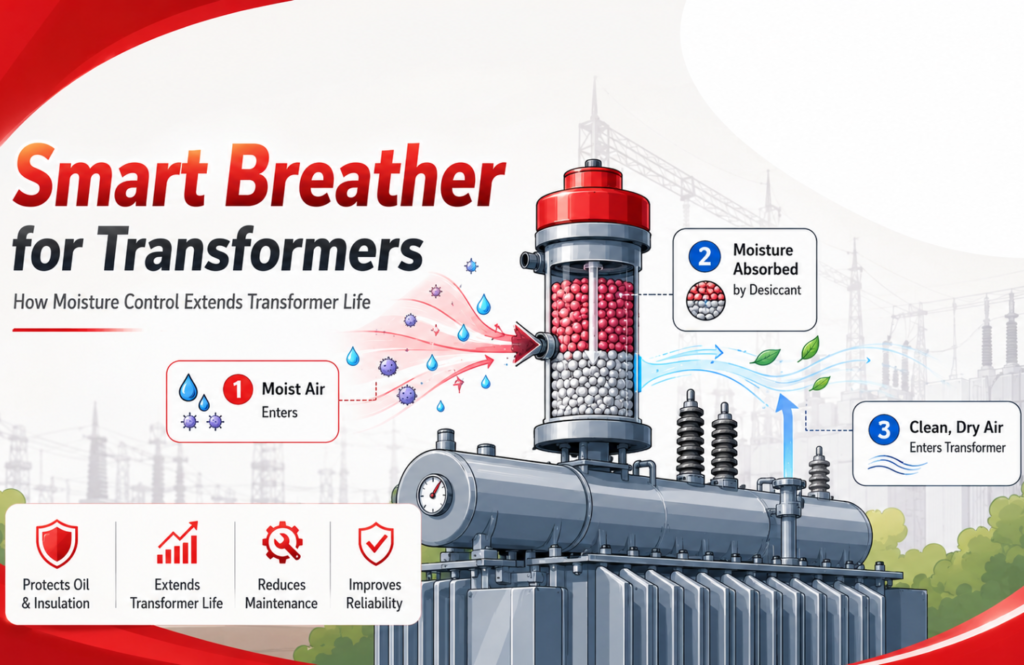
A smart breather is an advanced transformer moisture control system designed to prevent moisture ingress while reducing maintenance dependency.
Unlike conventional silica gel breathers that require regular replacement and visual inspection, smart breathers use automated regeneration systems and intelligent monitoring to maintain consistent performance.
Modern smart breather systems typically include:
- High-capacity silica gel
- Humidity sensors
- PLC-based control systems
- Built-in heaters
- Exhaust fans
- Automatic silica gel regeneration
When the desiccant reaches a predefined moisture level, the system automatically regenerates the silica gel and restores its moisture absorption capability.
This ensures continuous transformer protection throughout the year.
Limitations of Traditional Transformer Breathers
Conventional transformer breathers are effective but require ongoing maintenance.
In humid environments or demanding operating conditions, silica gel can saturate quickly, requiring frequent servicing and replacement.
Common Challenges with Traditional Breathers
Frequent Maintenance
Manual silica gel replacement increases operational workload.
Visual Monitoring Dependency
Operators must regularly inspect breather condition.
Higher Maintenance Cost
Repeated servicing increases lifecycle maintenance expenses.
Risk of Delayed Replacement
If saturated silica gel is not replaced on time, moisture can enter the transformer and affect insulation health.
For utilities and industries operating large transformer fleets, these maintenance challenges can become significant over time.
Key Benefits of Smart Breather Technology
Improved Transformer Moisture Control
Smart breathers continuously maintain moisture absorption efficiency and reduce the risk of atmospheric contamination.
Reduced Maintenance Effort
Automatic silica gel regeneration minimizes the need for manual servicing.
Better Transformer Oil Protection
Controlling moisture helps maintain oil dielectric strength and reduces oil degradation.
Extended Insulation Life
Lower moisture levels improve insulation reliability and reduce ageing.
Improved Transformer Reliability
Healthy oil and insulation conditions contribute to stable transformer operation.
Lower Operating Costs
Reduced maintenance frequency lowers long-term maintenance expenses.
Why Moisture Control Extends Transformer Life
Transformer insulation systems are extremely sensitive to water content. Even a small increase in moisture can significantly reduce insulation performance and accelerate ageing.
Effective transformer moisture control supports:
- Longer transformer service life
- Improved dielectric performance
- Reduced internal stress
- Better thermal stability
- Lower risk of insulation failure
- Improved transformer efficiency
In modern power systems, moisture management is no longer viewed as a simple maintenance task. It has become an important part of transformer reliability and lifecycle optimization.
Smart Breathers and Predictive Maintenance
Power utilities and industrial operators are increasingly adopting predictive maintenance strategies to improve asset performance and reduce unplanned downtime.
Smart breather systems support this approach by providing automated moisture management and improved operational consistency.
They are especially valuable in environments with:
- High humidity
- Heavy industrial loading
- Continuous transformer operation
- Remote installations
- Critical infrastructure requirements
By reducing dependence on manual inspection and recurring servicing, smart breathers help improve maintenance efficiency and operational reliability.
Applications of Smart Breathers
Smart breather systems are widely used across:
- Power transformers
- Distribution transformers
- Utility substations
- Renewable energy installations
- Industrial plants
- Critical electrical infrastructure
As transformer reliability expectations continue to rise, advanced moisture control systems are becoming increasingly important in modern electrical networks.
EMR Global’s Smart Breather Solution
EMR Global’s smart breather solution is designed to provide efficient transformer moisture control through automated silica gel regeneration and intelligent monitoring systems.
The solution combines high moisture absorption capability with humidity sensing, PLC-based controls, heaters, and exhaust fans to maintain consistent transformer protection.
By supporting healthier transformer oil condition and insulation reliability, EMR’s smart breather technology helps reduce maintenance dependency while improving long-term asset performance.
Conclusion
A smart breather for transformers is more than just an upgraded silica gel breather. It is an advanced moisture management solution designed to improve transformer reliability, protect insulation systems, and extend transformer life.
Investing in a smart breather for transformers helps improve long-term transformer oil protection and operational efficiency.
By reducing moisture ingress and supporting better transformer oil protection, smart breathers help utilities and industrial operators improve operational stability while lowering long-term maintenance effort.
As modern transformer systems continue to demand higher reliability and better asset performance, smart breather technology is becoming an essential part of transformer lifecycle management.