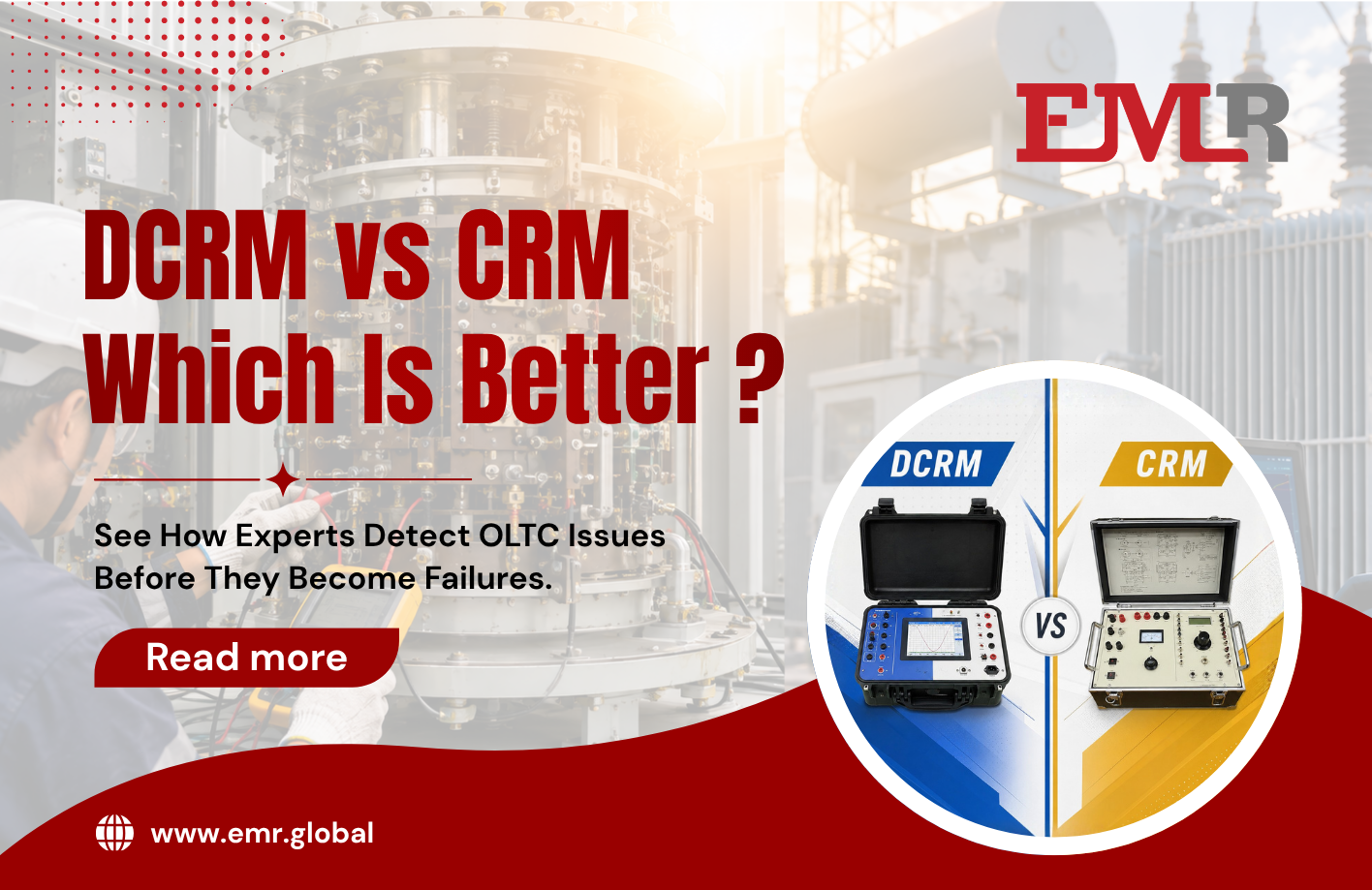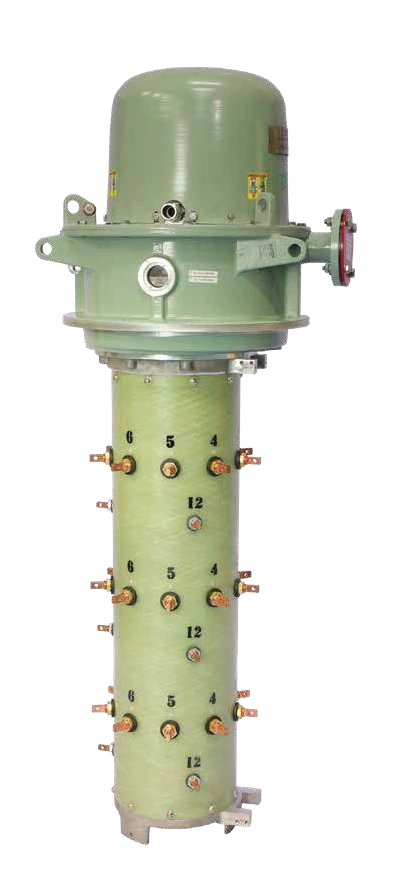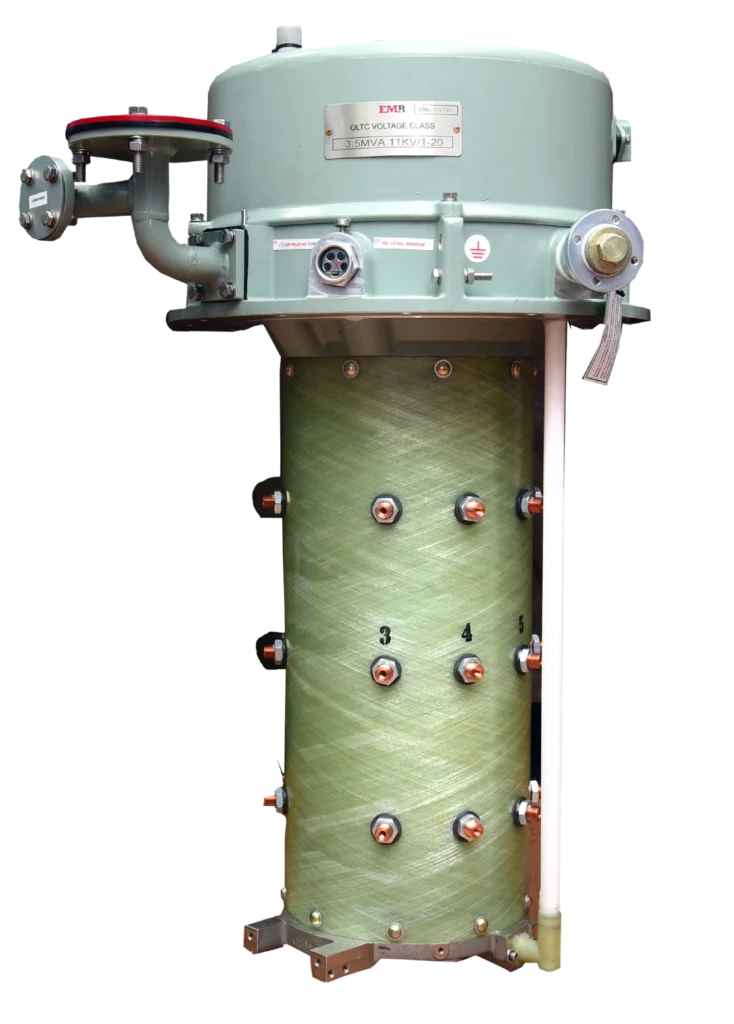
For decades, CRM (Contact Resistance Measurement) has been the standard test used to check the electrical health of an On-Load Tap-Changer’s (OLTC) contacts. It’s simple, well understood, and every testing team knows how to run it. But as transformers age and utilities move toward condition-based maintenance instead of fixed-interval overhauls, a more advanced method , DCRM (Dynamic Contact Resistance Measurement) , is increasingly being used for OLTC diagnostics.
This blog explains what CRM and DCRM actually measure, how they differ, and why EMR Global’s experts consider DCRM the more reliable path for present and future transformer testing and maintenance.
What Is CRM (Contact Resistance Measurement)?
CRM is a static test. It measures the electrical resistance across the OLTC’s contacts while the tap-changer is held at a fixed, stationary tap position, the transformer or tap-changer compartment typically needs to be opened, and the tap-changer is not operated during the measurement itself. The result is a single resistance value (or a set of values across different fixed tap positions) that tells you whether a contact’s resistance falls within an acceptable range at that moment.
CRM is useful for catching gross contact issues , badly worn, loose, or heavily oxidised contacts will usually show up as a high resistance reading. But because it only measures a static snapshot, it cannot show what happens during the actual tap-change operation, which is where much of the real mechanical wear and electrical stress in an OLTC occurs.
What Is DCRM (Dynamic Contact Resistance Measurement)?
DCRM is a dynamic test, on-load tap-changer diagnostic method that evaluates the condition of the OLTC without opening the tap-changer or the transformer tank. Instead of a single static reading, DCRM records the contact resistance continuously while the tap-changer actually operates through a tap change, capturing the entire transition switching sequence , selector movement, diverter switch operation, and transition resistor engagement , as a continuous current graph.
According to EMR Global’s testing methodology, the Dynamic Contact Resistance Measurement (DCRM) test follows a define procedure, and results are recorded systematically on a computer as current graphs rather than single numeric values. Specialists then analyse the shape of the resulting curve, commonly a characteristic “V” curve, zooming into specific sections to assess whether irregularities such as interrupter timing issues or contact bounce are present. After the measurement, the transformer can also be demagnetised using the same measuring instrument, streamlining the overall test sequence. EMR Global uses precision instruments from Ibeko (also known as DV-Power), developed specifically to EMR’s testing requirements.
DCRM vs CRM: The Core Differences
| Aspect | CRM | DCRM |
| Measurement type | Static, single fixed-position reading | Dynamic, continuous reading during actual tap operation |
| Data output | Single resistance value(s) | Full current graph capturing the entire switching sequence |
| Diagnostic depth | Detects gross contact wear or high resistance | Detects contact wear, misalignment, interrupter irregularities, and bounce |
| Fault localisation | Limited , flags a problem but not where in the operation it occurs | Precise , the graph indicates the location of the fault within the switching sequence |
| Downtime required | Requires the tap-changer to be held at fixed positions | Performed without opening the OLTC or transformer, minimising inspection downtime |
| Maintenance planning | Supports basic pass/fail assessment | Supports predictive, preventive maintenance planning with early wear detection |
Why DCRM Is Becoming Essential for Present and Future OLTC Testing
The transformer maintenance industry is shifting from calendar-based overhauls to condition-based maintenance, where equipment is serviced based on its actual measured state rather than a fixed number of years or operations. DCRM fits this shift far better than CRM for several concrete reasons:
- It sees the whole operation, not a snapshot. Because DCRM captures the entire tap-change transition as a graph, it can reveal problems , such as early-stage contact wear or interrupter irregularities , that only appear during actual switching, and that a static CRM reading at a fixed position would simply miss.
- It reduces overhauling time. Since the current graph pinpoints where in the switching sequence an anomaly occurs, technicians can target the exact issue during an overhaul instead of stripping down the entire tap-changer to search for it , directly reducing transformer outage time.
- It supports true predictive analysis. A single CRM value tells you the state of a contact today. A DCRM graph, tracked over successive tests, shows the trend of how contacts are degrading over time , which is what real predictive maintenance requires.
- It works without dismantling. DCRM condition-checks the OLTC without opening the transformer or tap-changer compartment, meaning healthy units can be confirmed as healthy without unnecessary intrusive inspection.
- It aligns with where the industry is heading. As OLTCs are asked to switch more frequently , driven by renewable integration and tighter voltage-quality requirements , the wear patterns that DCRM is specifically designed to catch will only become more relevant, not less.
CRM still has its place as a quick, low-cost check, particularly for simple compliance testing. But when the goal is a true, accurate analysis of OLTC health and a maintenance plan built on real data rather than assumptions, DCRM is the method that leads.
Frequently Asked Questions
What is DCRM in OLTC diagnostics?
(Dynamic Contact Resistance Measurement) is a diagnostic method used to assess the condition of an on-load tap-changer. It evaluates OLTC performance without opening the transformer or the tap-changer compartment.
Why is Dynamic Contact Resistance Measurement for OLTC important?
DCRM helps identify contact wear, misalignment, or degradation at an early stage by capturing the full switching sequence as a current graph. This supports preventive maintenance planning and reduces the risk of unexpected OLTC failures.
How does the DCRM test work on an OLTC system?
The DCRM test follows a defined test procedure where resistance values are recorded continuously during actual tap-change operations. The results are captured as current graphs on a computer system for detailed condition analysis.
What operational advantages does DCRM provide for transformer maintenance?
DCRM allows OLTC condition monitoring without dismantling the transformer or tap-changer. This minimises inspection downtime, reduces manual intervention, and supports faster, more accurate maintenance decisions than a static CRM reading.
When should utilities perform DCRM testing instead of standard CRM testing?
DCRM should be used during routine condition assessments or before planned maintenance cycles whenever an accurate, in-depth OLTC health evaluation is required without a full service interruption , particularly for ageing units or tap-changers with a high number of operating cycles.