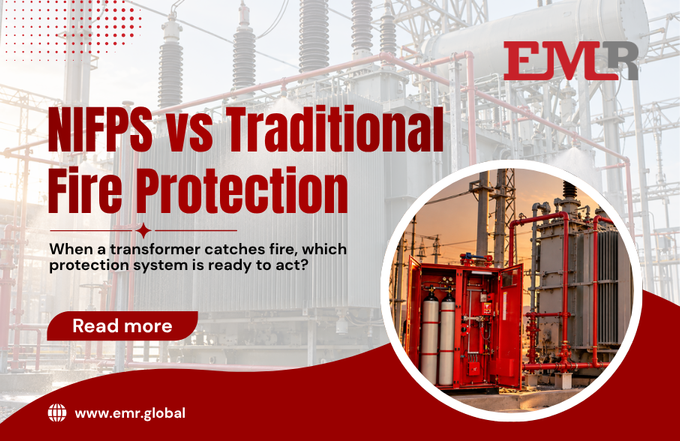
Power and distribution transformers are among the most expensive, most critical assets on any grid. When an internal arc or fault triggers a fire inside an oil-filled transformer, the damage is rarely limited to the unit itself , it can result in extended outages, safety hazards for on-site staff, and losses running into crores. This is exactly why NIFPS (Nitrogen Injection Fire Protection System) technology exists, and why utilities and industries across India are now comparing it against EMR Global’s advanced NITPS (Nitrogen Injection Transformer Protection System).
Both systems share the same core idea , using nitrogen gas to starve a transformer fire of oxygen , but they are not identical, and the difference matters when you are specifying protection for a multi-crore asset. This blog breaks down what NIFPS and NITPS actually are, the 5 key differences between them, and why EMR Global’s NITPS has become the recommended choice for power and distribution transformers.
What Is NIFPS?
A Nitrogen Injection Fire Protection System (NIFPS) is a transformer safety solution designed to reduce fire and explosion risk during internal transformer faults. When a fault such as arcing or a major internal short-circuit occurs, the decomposition of transformer oil releases flammable gases and increases internal pressure. A conventional NIFPS responds by draining a portion of the top oil and injecting nitrogen into the tank, creating an oxygen-starved atmosphere that suppresses combustion and prevents the tank from rupturing.
Most conventional NIFPS units operate on what is known as the “drain and stir” principle. They typically wait for confirmation from multiple protection devices , usually the differential relay working together with the Buchholz relay or the Pressure Relief Device (PRD) , before initiating the nitrogen injection and oil-draining sequence. This layered confirmation logic is safe, but it also means the system reacts only after a fault has already progressed to a certain severity.
What Is NITPS?
NITPS (Nitrogen Injection Transformer Protection System) is EMR Global’s advanced evolution of the same nitrogen-injection principle, engineered specifically for power and distribution transformers. Instead of relying only on downstream oil-surge confirmation, NITPS is built around patented Early Arc Detection technology. An arc sensor placed inside the transformer tank continuously monitors for the light and pressure signature of an internal arc. The moment an arc is sensed , together with the operation of any transformer protection relay , NITPS activates immediately, well before the fault can escalate into a full-blown fire or tank rupture.
In short: NIFPS is the industry-wide protection concept, while NITPS is EMR Global’s branded, next-generation execution of that concept, designed to detect and respond to faults faster and more reliably.
NITPS vs NIFPS: 5 Key Differences
1. Detection Method
A standard NIFPS depends on a chain of electromechanical confirmations, differential relay operation combined with Buchholz relay or PRD activation , before it acts. NITPS, on the other hand, uses a dedicated arc sensor for Early Arc Detection, sensing the fault at its source inside the tank rather than waiting for oil surge or pressure build-up to confirm it.
2. Response Speed
Because it detects the arc directly, NITPS activates in as little as 50 milliseconds , among the fastest response times in the industry. Traditional NIFPS systems, which rely on multi-relay confirmation logic, generally respond only after oil turbulence or pressure thresholds are crossed, which takes longer and allows the fault more time to develop.
3. Scope of Protection
Conventional NIFPS is primarily configured to respond to internal faults confirmed through oil-surge or pressure-based devices, with heat detectors added separately for external fires. NITPS is offered as a configurable range of functions covering arc sensor activation, heat sensor activation for external fires, and protection-relay-linked activation, giving it a broader, layered protection envelope within a single integrated system.
4. Monitoring and Surveillance
NITPS includes cloud-based 24×7 surveillance, allowing engineers and asset managers to track the health and readiness of the protection system remotely at all times. Legacy NIFPS installations are frequently standalone, panel-based systems without this level of remote visibility, which makes proactive maintenance harder to schedule.
5. Manufacturing Scale, Engineering Pedigree, and Support
NITPS is built by EMR Global, part of a transformer-accessories group with more than 80 years of collective experience and what is recognised as the largest NITPS manufacturing facility in India. This scale translates into tighter quality control, faster spares availability, and nationwide service support , factors that matter as much as the core technology when you are protecting a critical asset for the next 25–30 years.
Why EMR Global’s NITPS Is the Better, More Recommendable Choice
When you line up the five differences above, the pattern is clear: NITPS is not just “another NIFPS” , it is a purpose-engineered upgrade over the conventional nitrogen-injection concept.
- Faster fault isolation: Early Arc Detection at 50 msec means the protection system engages before a fault matures into a fire, reducing internal damage and the scale of repair.
- Configurable protection logic: Utilities can combine arc sensor activation, heat sensor activation, and protection-relay-linked tripping based on the specific risk profile of the installation, whether it is a power transformer, distribution transformer, renewable energy site, or industrial plant.
- Remote visibility: Cloud-based 24×7 surveillance means the protection system itself is monitored, not just the transformer, so it is always ready when it’s needed.
- Manufacturing depth and after-sales reliability: With decades of OLTC and transformer-accessory manufacturing experience behind it, EMR Global’s NITPS is backed by a support network built for long asset lifecycles.
- Designed for critical infrastructure: NITPS is well suited for grid-critical, industrial, and generation transformers where downtime and safety risk carry the highest cost.
For utilities and industries specifying fire protection during procurement, the decision increasingly comes down to how fast the system detects a fault and how well it is supported over the transformer’s operating life. On both counts, EMR Global’s NITPS is built to lead.
Frequently Asked Questions
What is NITPS in transformer protection?
NITPS (Nitrogen Injection Transformers Protection System) is a transformer fire-protection system that extinguishes fire by injecting nitrogen to eliminate oxygen inside the tank when faults occur internally or externally. It protects transformer health and nearby equipment by preventing tank explosions and oil fires.
Why is a Nitrogen Transformer Protection System important for transformers?
It is important because it stops combustion by removing oxygen inside the tank the moment a fault occurs. This reduces fire risk and limits internal fault damage, protecting high-value assets in critical power networks from oil fires and tank explosions.
How does NITPS improve transformer reliability?
NITPS continuously monitors the internal atmosphere of the transformer to prevent insulation breakdown from fault-related heat and gas build-up. This lowers overall failure probability and supports long-term reliable operation of the unit.
What does a Nitrogen Injection Fire Protection System do during internal faults?
During an internal fault, the system creates and maintains a controlled nitrogen blanket that restricts oxygen presence inside the tank. This limits fire hazard, reduces internal pressure rise, and minimizes further damage escalation.
When should utilities specify NITPS in transformer procurement?
NITPS should be specified whenever enhanced transformer safety, reduced fire hazard, and long-term asset protection are key procurement requirements , particularly for critical grid, industrial, and power-generation transformers.